
API Development and Integration Services
API development and integration connect your software to other systems, such as payment gateways, messaging platforms and internal tools. The connections are built to keep working under real load.
Overview
Most software depends on other systems: payment providers, messaging apps, AI services and internal tools. These links must work every time, not only during a demo.
We build APIs for systems we create, and we connect to third-party APIs such as payment gateways and WhatsApp.
REST is simple and works well for most APIs. GraphQL can help when apps need to ask for exactly the data they need. We choose the style based on your app.
When an outside service fails, your system should not fail with it. We use retries with a short wait, stop calls to a service that keeps failing, and keep failed messages for later review.
Every endpoint must check who is calling it. We also limit how many requests each caller can send, and we store keys and tokens in a secrets manager.
Integration work is the right service when you need to connect specific systems. If you need a full product, the integration may be only one part of the plan.
Who this service is for
Businesses whose systems need to exchange data reliably — internal tools, third-party platforms, or partner integrations.
When not to choose this service
Not the right choice if you do not yet know which systems must connect, or if an existing connector already works.

Engineering
Real Engineering Behind Every API Development and Integration Services Engagement
We document every endpoint and every outside connection. Each one is tested for failures, not only for the normal case.
Problems API Development and Integration Services solves
Fragile Third-Party Integrations
An integration built without real error handling breaks the moment the third-party API changes or has an outage.
No Versioning Strategy
An API with no versioning plan breaks existing consumers the moment it needs to change.
Inconsistent Data Contracts
APIs without a clear, typed contract lead to silent mismatches between systems that surface as production bugs.
Poor Error Visibility
A failed integration with no real logging means the first sign of a problem is a customer complaint.
Features
REST and GraphQL API Design
APIs designed around real consumer needs, with clear versioning from the first release.
Resilient Third-Party Integration
Payment gateways, WhatsApp, AI providers, and ERPs integrated with real error handling and fallback logic.
Typed, Documented Contracts
Clear, typed API contracts that catch mismatches at build time, not in production.
Monitoring and Alerting
Real visibility into integration health, so a failure is caught before a customer notices.
Benefits of API Development and Integration Services
Error Handling Built In
Calls are retried with a short wait, and failing services are paused, so one outage does not stop the whole system.
Versioned Changes
New versions are added without breaking existing apps or partners.
Monitored Connections
Errors and slow calls are logged and alerted, so problems are found early.
Connects Your Current Systems
Your existing payment, messaging and business tools are connected through their APIs.
Our Process
Each integration follows four steps, from the system map to ongoing monitoring.
- 01
Integration map
We list the systems to connect, the data they exchange and the rules for each one.
Integration map
- 02
API and security design
We design endpoints, authentication, rate limits and secret storage.
API design
- 03
Build and failure tests
We build each connection and test failures such as timeouts and bad data.
Tested integrations
- 04
Monitoring and changes
We monitor each connection and handle changes made by outside providers.
Monitored integrations
The API and integration tools we use
- Node.js
- GraphQL
- REST
- Stripe
- WhatsApp Business API
- PostgreSQL
Industries that use API Development and Integration Services
Where api development and integration services most commonly makes an impact.
- Finance
- Ecommerce
- Healthcare
- Logistics
System Integration
Enterprise Integration Suite
Typed, versioned, monitored APIs that connect your real systems reliably — not a fragile point-to-point script that breaks the next time a vendor changes their response format.
What’s Included
- REST/GraphQL API Design
- Third-Party Integration
- Typed Contracts
- API Versioning
- Monitoring & Alerting
- Rate Limiting & Auth
- Error Handling & Retries
- API Documentation Portal
Every Engagement Includes
- Integration Discovery Workshop
- Dedicated Integration Engineer
- System & Data Mapping
- Secure API Gateway
- Cloud Hosting & SSL
- Production & Staging Environments
- Uptime & Latency Monitoring
- Load & Failure Testing
- Developer Documentation
- Team Training on Monitoring Tools
- 30 Days Post-Launch Support
Starting From
PKR 250,000
Approx. USD $900 (reference only)
Final investment depends on your project scope, features, integrations, and business requirements discussed during the discovery session.
Every price is confirmed in writing before work begins — no hidden charges, ever.
Optional Add-Ons
- + Webhook Event Bus
- + GraphQL Federation Layer
- + Legacy SOAP Bridging
- + Partner API Portal
What Happens After Launch
Day 30
Launch
- APIs live in production across connected systems
- Team trained on monitoring dashboards
- Baseline latency & error rate captured
Day 60
Harden
- First versioned update shipped without breaking consumers
- Alert thresholds tuned from real traffic
- Slowest endpoints optimized
Day 90
Extend
- Roadmap for the next integration
- Third-party dependency risk reviewed
- Long-term API governance plan
Ownership
What you receive from API Development and Integration Services
Every api development and integration services engagement ends with the same ownership terms — nothing withheld, nothing licensed back to us.
API documentation
Each endpoint, its data, its errors and examples.
Integration source code
The code for each connection, with its tests.
Monitoring setup
Alerts and dashboards for each connection.
Failure playbook
What your team does when each outside service fails.
Frequently Asked Questions
What third-party APIs have you integrated with?
Payment gateways, messaging platforms like WhatsApp, AI providers, and ERP/CRM systems are common — the specific integration depends on what your business already runs on, scoped honestly per project.
What happens if a third-party API changes or goes down?
Integrations are built with real error handling and fallback logic, so a third-party outage degrades gracefully instead of breaking your whole system.
Do you build the API or just integrate with existing ones?
Both — we design and build new REST/GraphQL APIs for systems we build, and integrate with existing third-party APIs when that is what the project needs.
How do you handle API versioning?
A versioning strategy is decided at the start, not after the first breaking change is needed, so existing consumers are not broken by future updates.
Can you document the API for our own developers?
Yes — clear, typed API documentation is a standard part of the deliverable, not an afterthought.
How long does an API integration take, and what drives the cost?
The number of third-party systems and the quality of their documentation are the main factors — a well-documented, stable API integrates faster than one with sparse docs or known reliability issues.
What’s a common mistake teams make with API integrations?
Skipping real error handling because the integration works in testing. Third-party APIs fail in production eventually — the mistake is not planning for it upfront.
When is this NOT the right service to start with?
When there’s no existing system to build an API for or integrate with yet — if you’re building an application from scratch, API design is one part of that larger Custom Web Development or SaaS Development engagement, not a standalone starting point.
What should we have ready before an integration project starts?
Access to the third-party system’s documentation (or a contact who has it), and clarity on what should happen when that system is unavailable — a degraded mode, a queued retry, or a hard failure. That fallback behavior is a real business decision, not just an engineering detail.
What drives integration project complexity most?
The number of third-party systems and the quality of their documentation. A single, well-documented, stable API integrates quickly; several sparsely documented systems with inconsistent reliability add real discovery and testing time regardless of how simple each individual integration looks on paper.
How do API integrations typically change after launch?
Third-party providers deprecate endpoints and change rate limits over time, so ongoing monitoring and periodic updates are part of keeping an integration healthy — this is exactly what the Launch & Growth phase of our process tracks rather than treating the first successful request as the finish line.
Related Services
Cloud and DevOps Services
Cloud and DevOps services on AWS, Google Cloud and Azure. We set up deployments, monitoring and secure cloud infrastructure for your software.
Learn More about Cloud and DevOps ServicesSaaS Development Services
SaaS development for subscription software. We build multi-tenant apps with billing, user access and infrastructure that grows with your customers.
Learn More about SaaS Development ServicesEnterprise Software Development Services
Enterprise software development for internal systems. We build tools that connect to your existing systems and follow your access and audit rules.
Learn More about Enterprise Software Development Services

Delivery
After launch with API Development and Integration Services
After launch, we monitor the connections, handle changes made by outside providers and keep the documentation current.
Ready to Talk About API Development and Integration Services?
Tell us which systems need to talk to each other, and we'll tell you what a reliable integration actually takes.
Related Articles
- Security3 min read
API Security Checklist for Modern Applications
A practical API security checklist: authentication, input checks, rate limits, secrets and logging for modern applications.
ELACTRO Engineering Team · Jul 24, 2026
Read Article - Security3 min read
Building Secure Authentication Systems
How to build secure sign-in: password storage, multi-factor login, session handling and account recovery, explained in simple terms.
ELACTRO Engineering Team · Jul 24, 2026
Read Article 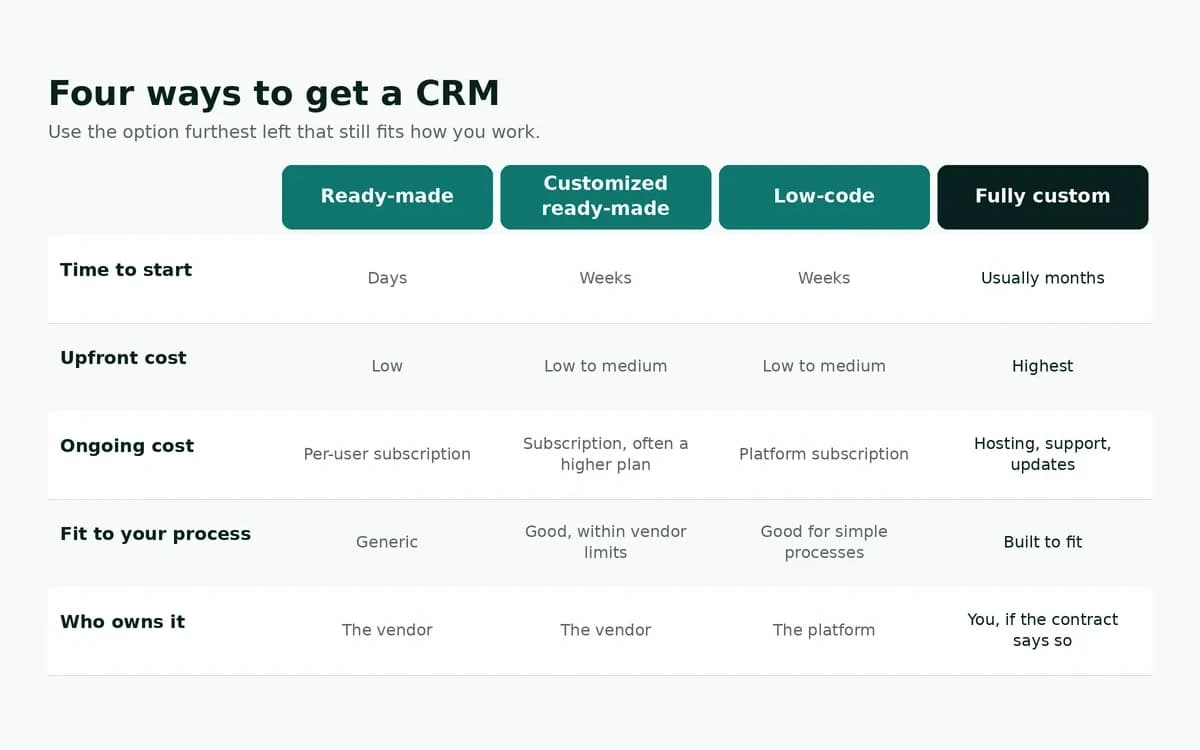 Software14 min read
Custom CRM Software Development: A Plain Guide for Small Businesses
When is a custom CRM worth it? A plain guide to the four ways to get a CRM, what a first version needs, 3-year costs, data migration and ownership.
ELACTRO Engineering Team · Oct 21, 2026
Read Article

