
Maintenance and Support Services
Maintenance and support keep your live software secure, fast and working. We handle updates, bug fixes, monitoring and small changes under a clear plan.
Overview
Software that is not maintained becomes risky over time. Libraries go out of date, small bugs stay unfixed and security patches get delayed.
Every project includes support during the first stretch after launch. Maintenance continues that support under an ongoing plan.
We start with a review of your current system. We check which libraries are out of date, where technical debt sits and which risks need fixing first.
Security maintenance means staying current: updating dependencies, fixing known weak points and reviewing who has access.
Traffic and data grow over time. We review server size and performance regularly, so the system keeps up with real use.
A monthly maintenance plan is worth it for systems your business depends on. For a small internal tool with low risk, occasional support on request may be enough.
Who this service is for
Businesses with a system already in production that needs reliable, ongoing attention — not a new build.
When not to choose this service
Not the right choice for a small internal tool with low risk. Support on request may be enough.

Engineering
Real Engineering Behind Every Maintenance and Support Services Engagement
Before maintenance starts, we agree on the response process and what each plan covers, so there are no surprises.
Problems Maintenance and Support Services solves
Unpatched Dependencies
Outdated dependencies accumulate real security risk the longer they go unaddressed.
Bugs Left Unfixed
Small issues that never get addressed compound into a system that feels increasingly unreliable.
No Ongoing Support Plan
Without a real plan, a critical issue has no agreed response time.
Performance Degrades Over Time
Without ongoing attention, real usage growth quietly degrades performance until it becomes a visible problem.
Features
AMC Plans
Annual maintenance coverage scoped to your system and its real support needs.
Security Updates
Dependencies and infrastructure kept current, closing vulnerabilities before they become incidents.
Ongoing Performance Optimization
Performance monitored and addressed continuously as real usage grows, not only at launch.
Feature Enhancements
New features added by the team that already knows the system, not relearned from scratch by someone new.
Benefits of Maintenance and Support Services
Response Times Agreed in Writing
Each plan sets response times based on how important the system is.
Security Updates Applied
Known vulnerabilities and outdated libraries are reviewed and patched on a planned schedule.
Performance Watched
Speed, errors and uptime are monitored, so trends are seen before users complain.
Clear Reports
You receive a report on what was changed, monitored and planned next.
Our Process
Support work follows four steps, from a health audit to regular improvement planning.
- 01
Health audit
We review your system’s libraries, known risks, performance and access rules.
Health audit report
- 02
Support plan
We agree on response times, what each plan covers and how urgent issues are handled.
Support plan
- 03
Ongoing care
We apply updates, fix bugs, watch performance and check backups.
Monthly care report
- 04
Review and planning
We review the results with you and plan the next improvements.
Improvement plan
The tools we use to keep systems running
- Next.js
- Node.js
- PostgreSQL
- Docker
- Monitoring & Alerting Tooling
Industries that use Maintenance and Support Services
Where maintenance and support services most commonly makes an impact.
- Healthcare
- Finance
- Ecommerce
- Manufacturing
Managed Care
Business Continuity Program
Ongoing security updates, monitoring, and an agreed response time — so the system you already built keeps running reliably instead of quietly decaying.
What’s Included
- Security Updates & Patching
- Bug Fixes
- Performance Monitoring
- Feature Enhancements
- Uptime Monitoring
- Agreed Response Times
- Monthly Health Report
- Priority Emergency Support
Every Engagement Includes
- Onboarding Systems Audit
- Dedicated Support Engineer
- Monitoring & Alerting Setup
- Secure Update Process
- Full System Access & Credentials Handover
- Agreed Response-Time Terms
- Monthly Performance Analytics
- Regression Testing on Every Fix
- Change-Log Documentation
- Escalation Path Training
- No Long-Term Lock-In Contract
Starting From
PKR 45,000 / month
Approx. USD $160 / month (reference only)
Retainer scope and response-time tier depend on your system's size and criticality, confirmed during the discovery session.
Every price is confirmed in writing before work begins — no hidden charges, ever.
Optional Add-Ons
- + Emergency 24/7 Hotline
- + Quarterly Security Audit
- + Feature Roadmap Planning Session
- + Dedicated Staging Environment
What Happens After Onboarding
Day 30
Onboarding
- Full systems audit completed
- Monitoring & alerting live
- First monthly health report delivered
Day 60
Stabilize
- Recurring issues from the audit resolved
- Response-time SLA tracked against real tickets
- Backup/recovery process verified
Day 90
Optimize
- Performance optimization pass completed
- Roadmap for the next feature enhancements
- Long-term maintenance plan reviewed
Ownership
What you receive from Maintenance and Support Services
Every maintenance and support services engagement ends with the same ownership terms — nothing withheld, nothing licensed back to us.
Health audit report
Findings on libraries, risks, performance and access.
Monthly care report
What was updated, fixed and monitored each month.
Support plan
Response times and escalation steps for your plan.
Improvement plan
Next improvements, ranked by risk and value.
Frequently Asked Questions
What is included in an AMC plan?
Security updates, bug fixes, performance monitoring, and a defined support response time, scoped to your specific system rather than a generic package.
Do you offer 24/7 support?
Yes, when the system's criticality warrants it — support tiers and response times are scoped to match how critical the system actually is to your business.
Can you maintain a system ELACTRO did not originally build?
Yes, after an initial audit of the existing codebase — we're honest upfront about what we find, including anything that needs remediation before an ongoing plan makes sense.
How do you handle urgent production issues?
Defined response times per support tier, with the on-call process scoped clearly at the start of the engagement, not improvised when an incident happens.
Is ongoing support required, or can we maintain the system ourselves?
Entirely optional — some clients maintain the system with their own team after launch, using our documentation; Maintenance & Support is for teams who want that work handled by the people who already know the system.
How is the cost of an AMC plan determined?
Scope is based on your system’s real complexity and how critical it is to your business — a plan is priced against your actual system, not a generic package tier.
What’s a common mistake companies make with post-launch maintenance?
Assuming a system that works today will keep working without attention. Dependencies age and security patches queue up quietly — the cost of catching up later is almost always higher than staying current.
When is a formal AMC plan not necessary?
For a low-stakes internal tool with no real uptime requirement, occasional as-needed support is often the more proportionate choice over a formal ongoing plan. We’ll recommend based on how critical the system genuinely is to your business, not push a plan tier by default.
What should we have ready before a maintenance audit?
Access to the existing codebase, hosting environment, and any documentation that exists, even if incomplete — the audit’s job is to establish the real current state, so gaps in documentation are expected and simply become part of what the audit surfaces.
What affects maintenance plan complexity and cost most?
How much technical debt and how many outdated dependencies the initial audit finds, plus how critical the system is (which sets the required response time). A well-maintained recent system costs far less to keep current than one that has gone years without attention.
How does a maintenance relationship typically evolve over time?
It often expands from pure upkeep into incremental feature work, since the team already understands the system’s architecture — many clients find it more efficient to route new feature requests through the same maintenance relationship than to re-engage a separate team that has to relearn the system first.
Related Services
Cloud and DevOps Services
Cloud and DevOps services on AWS, Google Cloud and Azure. We set up deployments, monitoring and secure cloud infrastructure for your software.
Learn More about Cloud and DevOps ServicesEnterprise Software Development Services
Enterprise software development for internal systems. We build tools that connect to your existing systems and follow your access and audit rules.
Learn More about Enterprise Software Development ServicesSaaS Development Services
SaaS development for subscription software. We build multi-tenant apps with billing, user access and infrastructure that grows with your customers.
Learn More about SaaS Development Services

Delivery
After launch with Maintenance and Support Services
We report what we changed, what we monitored and what needs attention next.
Ready to Talk About Maintenance and Support Services?
Tell us what's already running and what's worrying you about it, and we'll tell you honestly what ongoing support should look like.
Related Articles
- DevOps3 min read
Scaling Modern Web Applications Without a Rewrite
How to scale a modern web application step by step, without a full rewrite: caching, database limits, queues and the monitoring that tells you what to fix next.
ELACTRO Engineering Team · Jul 24, 2026
Read Article - Security3 min read
API Security Checklist for Modern Applications
A practical API security checklist: authentication, input checks, rate limits, secrets and logging for modern applications.
ELACTRO Engineering Team · Jul 24, 2026
Read Article 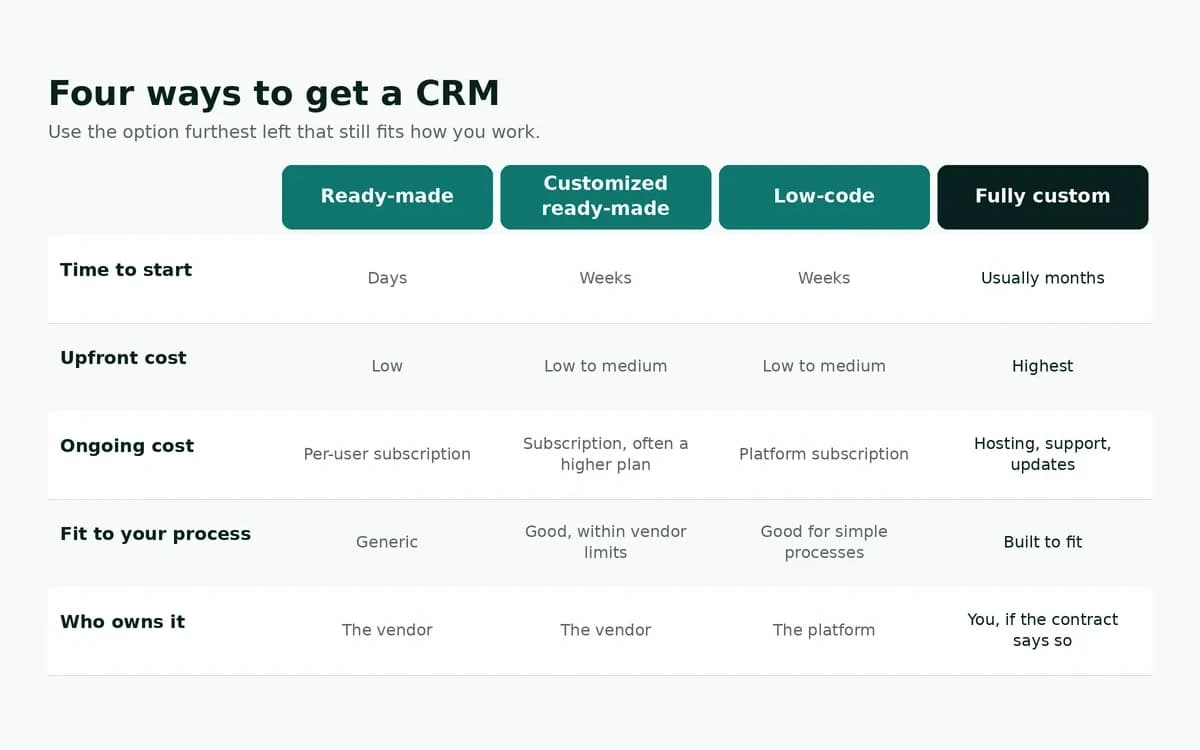 Software14 min read
Custom CRM Software Development: A Plain Guide for Small Businesses
When is a custom CRM worth it? A plain guide to the four ways to get a CRM, what a first version needs, 3-year costs, data migration and ownership.
ELACTRO Engineering Team · Oct 21, 2026
Read Article

