
Custom Web Development Services
Custom web development builds a web application around your workflow and data. You get a system that fits how your business works, not a tool you have to bend to fit.
Overview
Off-the-shelf platforms are quick to start with. They become hard to change once your workflow grows beyond their limits. A custom build removes that limit.
We design the system around your real workflow and data model. We use a modern, well-documented stack that your team, or ours, can maintain and extend.
A typical design has three parts: a web front end, an API layer and a database with a clear structure. This separation lets each part change without breaking the others.
Security is part of the request path from the start. This includes sign-in, role-based access to pages and data, and input checks wherever users send information.
Changes go through automated tests and a preview before they reach users. This lowers the risk of a broken release.
A custom build is the right choice when your workflow, data or integrations no longer fit a generic platform. If a standard tool already covers your needs, it is usually cheaper to use it.
Who this service is for
Businesses whose workflow no off-the-shelf platform fits cleanly, where that mismatch is now costing real time or money.
When not to choose this service
Not the right choice if a standard tool already covers your workflow, or if a brochure site is all you need.

Engineering
Real Engineering Behind Every Custom Web Development Services Engagement
We write code for your workflow, with tests for the parts that matter most. The code is documented so your team can maintain it.
The Alternative
Off-the-Shelf Ceiling vs. a Custom Build
The same limitations that push a business toward a custom build, next to what replaces each one.
The Off-the-Shelf Ceiling
Off-the-Shelf Tools Don’t Fit
Your workflow gets bent to match a generic tool’s assumptions instead of the other way around.
Technical Debt From a Prior Build
An earlier version of the site has become difficult and risky to change.
Slow, Bloated Performance
Page loads and interactions lag behind what users now expect as a baseline.
Hard to Extend
Adding a new feature takes far longer than it should, because the underlying architecture wasn’t built to grow.
What a Custom Build Gives You
Bespoke Architecture
A system designed around your actual data model and workflow, not a generic CMS schema.
Responsive, Accessible UI
Interfaces that work cleanly across devices and meet WCAG 2.2 AA as a baseline, not an afterthought.
Third-Party & Internal API Integrations
Clean integration with the other systems your business already depends on.
CMS & Admin Tooling
Internal tools for your team to manage content and data without needing an engineer for every change.
Performance Optimization
Built against Core Web Vitals budgets from the start, not tuned after launch.
Long-Term Maintainability
A modern, well-documented codebase that can be handed to another engineering team without a rewrite.
Delivery
How a Custom Web Development Services project runs
The same disciplined process behind every custom web development services engagement, from first conversation to production.
04 Steps
- 01
Workflow audit
We follow how your team works today, including the manual steps that cause delays. Output: Workflow and data map.
- 02
Architecture and screens
We plan the system structure and design the main screens for your team. Output: Architecture and screen designs.
- 03
Build in releases
We build in short releases and show progress on a staging site. Output: Working releases.
- 04
Launch and handover
We release the system, train your team and hand over the code and documentation. Output: Production system and handover pack.
Stack
The stack behind custom web applications
Benefits of Custom Web Development Services
An Exact Fit to Your Workflow
The system matches how your team actually works, instead of the other way around.
Faster Page Loads
A lean, purpose-built architecture outperforms a general-purpose platform carrying features you never use.
Easier to Extend
New features build on a foundation designed for growth, not around it.
Lower Long-Term Maintenance Cost
Clean architecture and current tooling reduce the ongoing cost of keeping the system healthy.
Industries that use Custom Web Development Services
Where custom web development services most commonly makes an impact.
- Real Estate
- Education
- Ecommerce
- Startups
Launch Your Own Profitable Business
A complete, done-for-you affiliate business package — from strategy to scale.
Everything you need in one package. No technical stress. No guesswork. Just real guidance and a system that works.
What's Included
14 essential components to launch, manage and grow your affiliate business successfully.
- 01
Business Strategy
Clear direction, business model & step-by-step plan.
- 02
Affiliate Website & Tools Website
Professional, high-converting websites built for results.
- 03
Backend & Admin Panel
Powerful backend with easy management and full control.
- 04
Affiliate Program Setup
Everything configured and ready to go live.
- 05
Content System
Structured, SEO-friendly content system.
- 06
Niche Research
Data-driven niche selection with real market potential.
- 07
SEO Foundation
On-page SEO, technical setup and best practices.
- 08
Marketing System
Ready-to-use marketing tools and strategies.
- 09
Analytics & Tracking
Track performance and growth in real time.
- 10
Google AdSense Preparation
Complete setup and approval guidance.
- 11
7 Days Guidance
Dedicated support during your first 7 days.
- 12
30/60/90 Growth Roadmap
A clear plan for consistent, long-term growth.
- 13
Domain & Hosting Setup
Domain registration and reliable hosting included.
- 14
Source Code Included
You own everything. No limitations.
Special Investment
Previous price: PKR 500,000
Price: PKR 350,000
Approx. USD $1,250 (reference only)
50% advance · 50% on completion
- Complete Business Launch
- Full Ownership
- Domain & Hosting Included
- Training & Support Included
Let's discuss your goals and how this package can work for you.
Trusted Process
Clear steps, no hidden surprises.
Expert Guidance
Same team, long-term support.
Growth Focused
Built for real results.
Your Business, Your Assets
You own everything we deliver.
Global Possibilities
Start local, grow anywhere.
Affiliate Package Questions
Is this just a website, or something more?
The Complete Affiliate Business Launch Package is more than a website — it's a complete online business launch system. The website is one part of it; the package also covers business and niche strategy, brand direction, a production-grade backend, an enterprise admin panel, a real SEO foundation, and seven days of hands-on training, delivered as one accountable engagement rather than a website handed off on its own.
Do I need to already have a business idea or niche?
A general direction helps — a niche, an audience, or a market you understand. The package includes niche validation and market research to sharpen that direction into a real strategy, but it starts from your input, not a blank page; we don't assign or invent a business idea on your behalf.
Will I be able to manage the site myself after launch?
Yes — that's the point of the admin panel and the seven-day training. You'll be able to manage content, affiliate links, and settings yourself without needing a developer for routine changes.
What happens after the 7 days of training?
You receive full documentation alongside the training, and you own the system outright from handover. Ongoing help beyond that point is available separately through our Maintenance & Support service, but nothing about running the business depends on continuing that relationship.
Does ELACTRO guarantee affiliate program approval or income?
No, and we're direct about that. No legitimate engineering team can guarantee affiliate-network approval, search rankings, or revenue — those depend on factors outside a website build. What we can guarantee is a real, well-architected system built to give the business a genuine chance to perform.
How long does the full package engagement take?
The full process — discovery, research, planning, development, QA, launch, training, and handover — is scoped individually based on the specifics of your business, and we lay out a real timeline before work begins rather than quoting a generic turnaround.
What determines the final investment beyond the starting price?
Scope drives cost — the number of content types, the depth of the admin panel, and any custom integrations beyond the standard package. We scope every engagement against your actual requirements rather than quoting a flat package price.
Can this be built around a brand or name I already have?
Yes. Brand direction is part of the package whether you're starting from scratch or already have a name and identity — in the latter case, we build around what you have rather than replacing it.
Who owns the source code and the system after launch?
You do, outright, from handover — full source code, backend, and admin panel access, with no ongoing dependency on ELACTRO to keep the system running.
Does ELACTRO guarantee Google AdSense approval?
No, and we're direct about that. AdSense approval is Google's decision, based on criteria and a review process no agency controls. What we do is prepare the site to meet the technical and content standards ad networks look for — the application decision itself is never ours to guarantee.
What does the 7-day business guidance actually cover day to day?
It's hands-on, not theoretical — the admin panel, content management, affiliate link setup, SEO operations, the marketing channels set up during the build, day-to-day business operations, and a walkthrough of your 90-day growth roadmap. By day 7 you should be able to run the business without depending on us for routine work.
Is the USD figure the actual amount I get invoiced?
No — PKR is the real invoicing currency. The USD figure shown alongside the price is an illustrative approximation only, not a live conversion, so international clients have a rough sense of scale. Your actual invoice and final confirmed figure are always in PKR.
How does the 50/50 payment plan work?
50% is due as an advance to begin work, and the remaining 50% is due after successful completion and business handover — you are not paying the full amount before the system is built and working.
How does deployment work for the package?
The system is deployed to production infrastructure as part of the package, tested and verified before handover — you're not left to figure out deployment yourself once development finishes.
Ownership
What you receive from Custom Web Development Services
Every custom web development services engagement ends with the same ownership terms — nothing withheld, nothing licensed back to us.
Application source code
The complete codebase for the web application, in a repository your team controls.
Architecture document
How the system is structured, which decisions were made and why.
Admin guide
Step-by-step instructions for managing users, content and settings.
Handover session
A live walkthrough with your team before handover.
Frequently Asked Questions
Related Services
Mobile App Development Services
Mobile app development for iOS and Android. We build native or cross-platform apps that work well on real devices and are easy to maintain.
Learn More about Mobile App Development ServicesEcommerce Development Services
Ecommerce development for custom stores and checkout. We build fast storefronts, accurate inventory and secure payments that hold up during busy sales.
Learn More about Ecommerce Development ServicesSaaS Development Services
SaaS development for subscription software. We build multi-tenant apps with billing, user access and infrastructure that grows with your customers.
Learn More about SaaS Development Services

Delivery
After launch with Custom Web Development Services
After launch, we monitor the application, fix issues and add features as your business changes.
Related Case Studies
Real projects where ELACTRO delivered this service.
Ready to Talk About Custom Web Development Services?
Tell us about the workflow your team is stuck working around, and we'll tell you what a purpose-built application looks like.
Related Articles
- Web19 min read
Custom Web Development in Dubai: The Complete 2026 Guide
A complete guide to custom web development in Dubai: what it means, when a custom build makes sense, and how a real project is priced and run.
ELACTRO Engineering Team · Aug 1, 2026
Read Article - DevOps3 min read
Scaling Modern Web Applications Without a Rewrite
How to scale a modern web application step by step, without a full rewrite: caching, database limits, queues and the monitoring that tells you what to fix next.
ELACTRO Engineering Team · Jul 24, 2026
Read Article 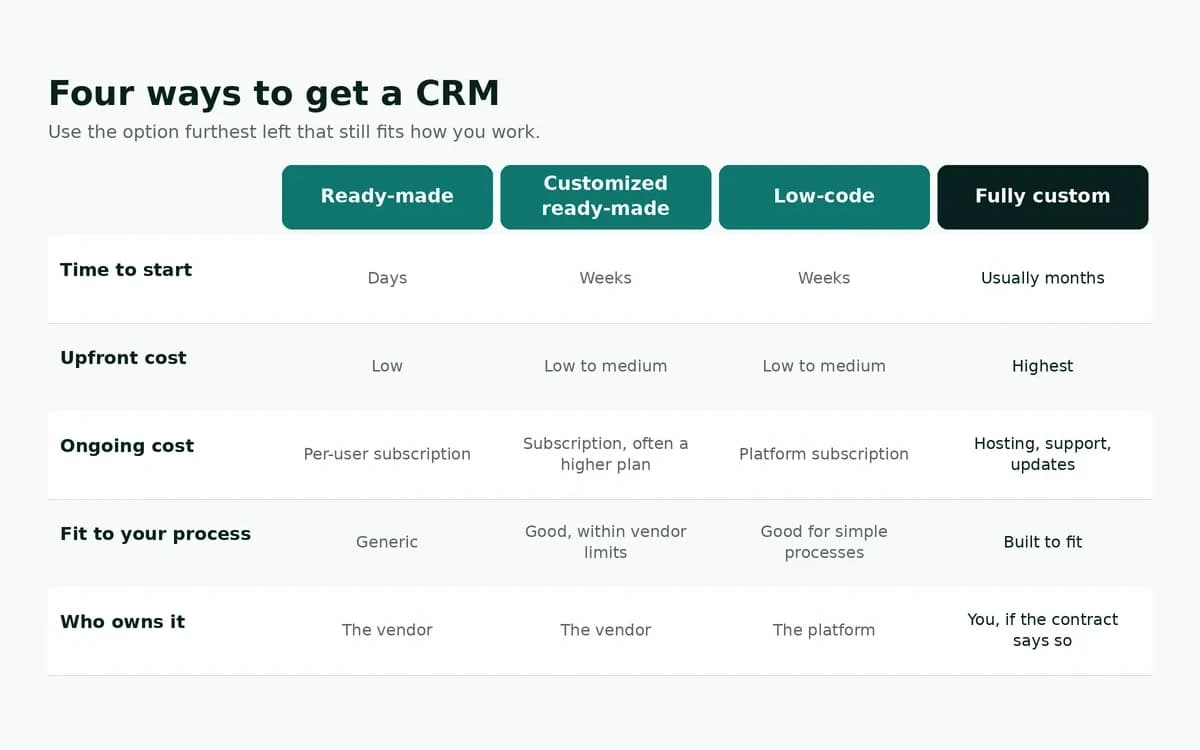 Software14 min read
Custom CRM Software Development: A Plain Guide for Small Businesses
When is a custom CRM worth it? A plain guide to the four ways to get a CRM, what a first version needs, 3-year costs, data migration and ownership.
ELACTRO Engineering Team · Oct 21, 2026
Read Article

